April 29, 2026
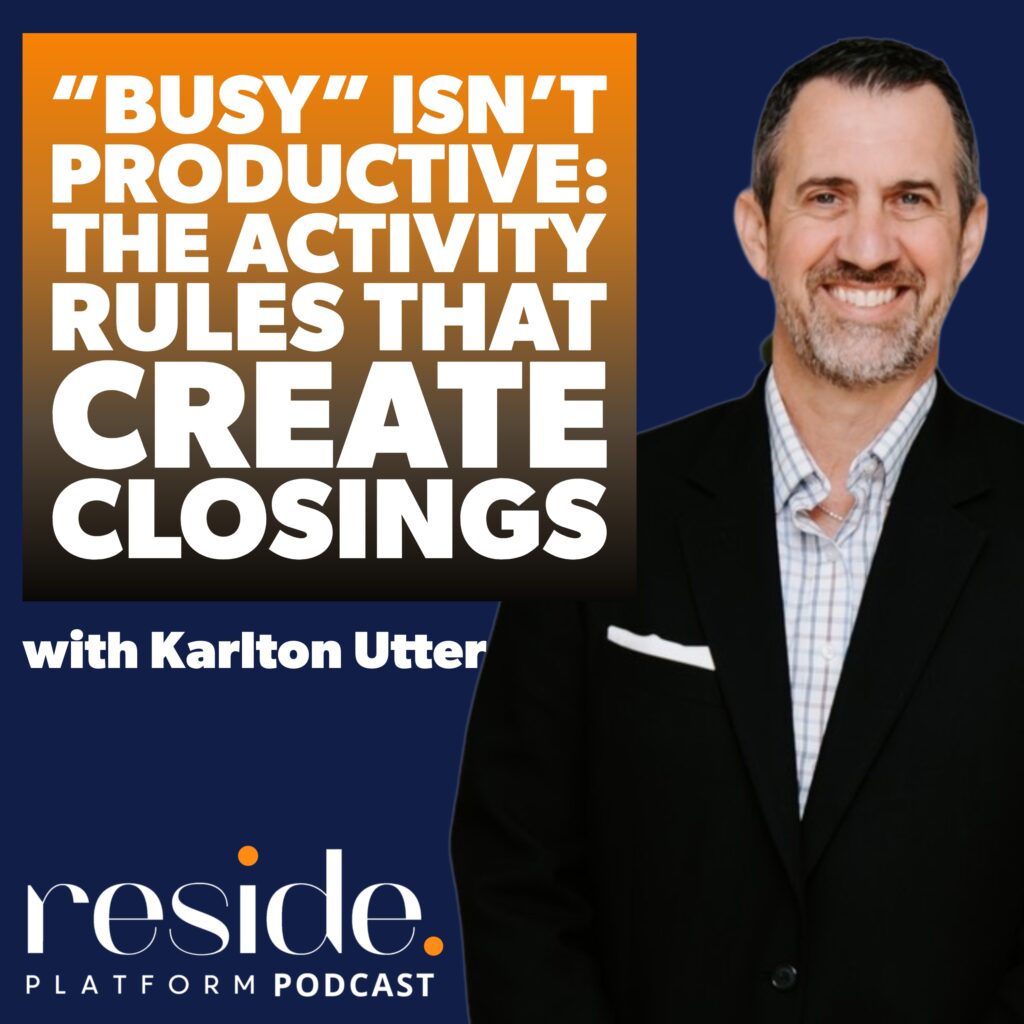
If you feel like you are working hard but the results are not showing up, this episode breaks down what is really missing. Lauren sits down with Karlton Utter, head of agent training and development at Reside, to talk about the habits that separate agents who “stay busy” from agents who consistently close. Karlton shares how treating real estate like a true business, time blocking prospecting, and asking for the business directly can change everything, especially in shifting markets. They also cover how to stop discounting your value, why listings create momentum, how to use technology without losing the fundamentals, and why a full pipeline protects your mindset when deals fall apart.
Chapters:
- (00:00:00) Every personality can succeed with the right mindset and work ethic
- (00:02:20) Treat real estate like a career, not a hobby: business owner mentality
- (00:04:40) The 9-to-5 approach: daily prospecting as a non-negotiable
- (00:06:50) Old-school pipeline building that still works: FSBOs, expires, and community
- (00:09:30) Social media as a “Rolodex”: building a brand people remember
- (00:12:10) Using social media for business: training, consulting, and staying adaptable
- (00:16:40) Third-party leads vs. listings: why listings create the “power of one” effect
- (00:20:10) Holding your commission: how discounting hurts your future business
- (00:24:30) Know your numbers: hourly wage, market knowledge, and being the expert
- (00:29:10) Ask for the business: getting clarity instead of the “parking lot shuffle”
- (00:32:00) Eat the frog: daily prospecting habits, time blocking, and pipeline protection
- (00:36:00) Next-level growth: niches, farm areas, and increasing average sales price
- (00:38:00) Mindset and long-term planning: goals, support systems, and staying consistent
Links and Resources:
- Karlton Utter on LinkedIn
- Team Leader Secrets by Suneet Agarwal
Thanks so much for joining us this week. Want to subscribe to the Reside Platform Podcast? Have some feedback you’d like to share? Connect with us on Spotify, Apple Podcasts and YouTube to leave us a review!
KEY QUESTIONS ANSWERED —
Read More
Q: What’s the key mindset every successful real estate agent needs?
A: You need to treat real estate as a true career, not a side gig. Success comes from having the right mindset, being activity-driven, and committing to daily prospecting and business-building tasks, especially when you’re just starting out.
Q: How did Karlton start generating business when he had no leads?
A: He treated real estate like a nine-to-five job, coming into the office every day to prospect. He called FSBOs, expireds, neighbors, and anyone he could find, always looking for a reason to reach out and introduce himself as the local agent.
Q: What’s changed for agents with today’s technology?
A: Technology has made marketing and lead generation easier than ever. Social media and AI tools allow agents to connect with more people and automate tasks, but the fundamentals—activity and relationship-building—are still what drive success.
Q: How should agents position themselves if they don’t have access to third-party lead sources like Zillow Flex?
A: Focus on listings and building a strong community presence. Listings create more opportunities and visibility, so get involved locally, tell everyone you’re in real estate, and use every listing to generate more business.
Q: How do you handle commission pressure without devaluing your service?
A: Stand your ground and know your worth. If you discount for one client, others will expect it too. Track your income and hours to understand your true value, and only negotiate commission when absolutely necessary.
Q: What’s the most important thing agents should track in their business?
A: Track your deals, commissions, and hours worked so you know your real hourly wage and can set realistic income goals. Use simple tools like Google Sheets or Excel, and leverage AI to automate calculations and reporting.
Q: What’s the biggest mistake agents make when they get busy?
A: They stop prospecting and filling their pipeline. Even when you have multiple deals under contract, you need to keep making calls and building relationships so you don’t run out of business in the next 90 days.
Q: How do you create raving fans and repeat business?
A: Become a true expert in your market—know your numbers, trends, and inventory inside and out. Guide clients through tough conversations and decisions, and always position yourself as a trusted advisor, not just someone who opens doors.
Q: What’s the one thing agents can do every day to win?
A: Make calls and have real estate conversations. Aim for 35 two-minute conversations a week (about seven a day). Consistent daily action is the foundation of a sustainable, growing business.
THE TRANSCRIPT —
Read More
Karlton: [00:00:00] I have found that every personality can be successful in real estate if you have the right mindset and work ethic behind it. That’s the key is coming into this like you have to want to work, especially when you first get started in the business and it’s like you’re looking around waiting for somebody to tell you what to do, and that’s not necessarily what real estate is.
Karlton: You gotta go out and you gotta find people and tell them that you’re in the business and you have to be activity driven.
Lauren: Welcome back to the Reside Platform Podcast. I am Lauren Holland, director of Client Experience here at Reside, and today we have someone in the studio who I, am really excited to sit down with because this conversation is going to hit different. For a lot of you. So if you are an agent who feels like you are putting in the work, but something still isn’t [00:01:00] clicking, or a team leader who knows your people have potential but can’t quite unlock it, this one’s for you.
Lauren: Our guest today is Carlton Ter. Hi Carlton.
Karlton: Hi Lauren.
Lauren: He is our head of agent training and development here at Reside, and I just wanna give you all, before we get into it, a little context for who this guy is, because his background is not small. Carlton, if I miss anything, feel free to introduce yourself.
Lauren: Sure. he has built sales operation frameworks supporting 450 plus agents across multiple states. Developed national training programs adopted by over 10,000 agents. he’s led Zillow preferred program expansion for one of the top converting Zillow companies in the country. He has launched. I’m not done yet.
Lauren: He has launched new markets from scratch, from the assessment all the way through to performance. and he’s done all of this at both the local and national level. Have I forgotten anything, Carlton?
Karlton: It [00:02:00] sounds really good when you say it. I’m like, man, that guy did a lot.
Lauren: I’m like, I’m gonna take a breath ’cause I’m still going.
Lauren: I love it.
Karlton: I’ve been very lucky, lucky and privileged to, to be in this industry for a long time now, and I’ve done sales, I’ve managed offices, I’ve done recruiting, training, marketing, I mean, you name it, I’ve probably done it in this business.
Lauren: Yeah, well I used to call myself a Swiss Army knife, but it turns out that’s you now.
Lauren: So I am handing over the torch to you. So Awesome. So now you’re here at Reside and you’re working directly with our agents and teams Every single. So Carlton Ooh, welcome to the podcast.
Karlton: Well, thank you. I’m thrilled to be here.
Lauren: Yay. Okay, so before we get into everything I have to ask, because you’ve worked with agents at every level, local markets, national brands, enterprise operations, what’s the one thing that’s consistent across all of them?
Karlton: the one thing that’s [00:03:00] consistent with us when we’re dealing with residential real estate is it’s still a, a. A people business, right? Mm-hmm. It’s still about the relationships that the agents form with their potential clients and current clients to create a client for life approach. now the one thing that I find differs between agents that have found success in the business and those that haven’t is that you need to treat this as a career.
Karlton: Mm-hmm. You need to look at this as I own a business. For those that come into it and treat it like a hobby or I love watching HGTV and I show three houses and they pick one it, that is not how this business is. And the beauty of real estate is that I am a big. Believer of the DISC profile and understanding your personality and I think that it’s really important to know what your personality is so you can adjust it to be able to work better with others.
Karlton: And I have [00:04:00] found that every personality can be successful in real estate if you have the right mindset and work ethic behind it. That’s the key is coming into this like you have to want to work, especially when you first get started in the business and it’s like you’re looking around waiting for somebody to tell you what to do, and that’s not necessarily what real estate is.
Karlton: You gotta go out and you gotta find people and tell them that you’re in the business and you have to be activity driven. And the big thing for me. Is that when I moved into sales, I had already been doing marketing and recruiting in the business, and then I moved into sales and I sat through, at the time, it was a two week, five days a week, all day, nine to five training program, and they taught you everything from A to Z.
Karlton: And I wasn’t going to pretend to know what was gonna work, what wasn’t. I wasn’t one of those that was like, oh, I’m not gonna do this. That makes me uncomfortable. I’m like, look, [00:05:00] they just gave me the roadmap, how to sell real estate. I’m gonna do all of it. And. that’s what really helped me kickstart my real estate career in sales very quickly, is I just jumped right in and I learned from my mistakes and I learned from my successes.
Lauren: Mm-hmm. Well, we had a conversation this morning about, what gets in the way of getting into that activity. What, where did you start for someone that might be stuck or not in production yet?
Karlton: I took a, an approach that I was a nine to five employee when it came to my business. Now I understood that I needed to show properties and be available on the weekends.
Karlton: ’cause quite honestly, that’s when our clients are available.
Lauren: Mm-hmm.
Karlton: But for me, it was making sure that I was prospecting at least an hour or two every single day. And that’s the part that I think a lot of people struggle with is. Well, who do I call? How do I fill my pipeline? I’m uncomfortable. I don’t wanna bother [00:06:00] people.
Karlton: I didn’t have leads that were handed to me when I started selling. This was the early two thousands. I’m really dating myself. You used to have to come in the office to get on the MLS because it was only on one computer. It wasn’t like how Oh, wow. Everything is with you. if you, there was an offer coming in, you sat by the fax machine, like waiting, like, when is this offer coming in here?
Karlton: And then you’d have to wait for it to slowly print out. And then of course, me’s lawyer would run outta ink halfway through and you’re like, I just, the offer.
Lauren: Right. I don’t think you’re dating yourself. I think many of our listeners right now are laughing along with you because they remember exactly what you’re talking about.
Karlton: Yeah, luckily I missed the time of the business when the MLS was in book form.
Lauren: Oh,
Karlton: God. So I understand that before it moved to the computer, you used to get a book that was sent to the office, and if you had a client for a house and you didn’t want anyone else to see it, you would rip the paper out of the book.
Karlton: So nobody else knew it was available, so [00:07:00] I missed those days. But,I was in the office e every day. And I was making my calls and I’d come in, get my cup of coffee, say hi to everybody that was in, and I would just start dialing. I called Fizbos, I called expires. I called my people that lived in my neighborhood just to introduce myself.
Karlton: I called into neighborhoods to invite people to open houses and to tell ’em about new listings and to see if they knew anyone thinking of buying or selling. I just found a reason to, to prospect and back then. Email and text was just getting started. So it was really just about picking up the phone and I kind of cut my chops doing it that way.
Karlton: Mm-hmm. now you have a much more integrated approach. Marketing is at a whole different level with social media now you can really showcase a property. we had newspaper ads that were little, tiny black and white ads that were abbreviated to the point you had no idea what they were even talking about.
Karlton: And the marketing and what we [00:08:00] have now to help create those opportunities, I would’ve killed for that in full-time sales. But it was just treating it like a job. And there were days where I would finish everything I needed to by four o’clock. I could have gone home, I could have, taken the afternoon off and spent time with my kids, and I would’ve loved to have done that.
Karlton: But I said, no, I’m committed to doing this as a career. And I stayed until five o’clock. And you know what? It was always, whatever it was I came up with making a few more calls, sending out a handwritten note to somebody. Whatever it was I did that last hour almost always turned into business for me.
Lauren: Mm-hmm. Yeah. And that’s a testament to your growth as well, because look at where you’re, sitting today, you are, you’ve had your hands, working with so many thou, tens of thousands of agents. Based on your experience. and I wanna go into, because, you said a couple of things that I wanna go down a rabbit hole into, but especially with the technology that’s at everybody’s [00:09:00] fingertips, especially with AI and the marketing, and you can literally tell AI now the brand colors you want, make me a presentation or go make me a graphic.
Lauren: You, it’s cutting out a lot of the VA work, for teams and it’s never been easier. I would say, and I wanna, I really wanna take this into leads and calling and getting agents into activity because you just highlighted something really good. You had to call people, you didn’t have people handing you leads.
Lauren: I’m guessing Zillow,flex didn’t, exist back then. Correct.
Karlton: So I remember when I was selling real estate, I was so excited to have a website.
Lauren: Yeah,
Karlton: that website was a realtor.com landing page. Okay. So at the time, realtor.com was really weeding the way because it was actually connected with the, the National Association of Realtors before it went private.
Karlton: so we didn’t have Zillow. We had realtor.com. I’m trying to think what other sites we had at the time. Maybe Trulia. It was just getting [00:10:00] started and that eventually got bought and turned into the powerhouse. What Zillow is now when they combine forces and Yahoo might have had a real estate search or something along that line as well.
Karlton: but technology really. Right around 2007 and 2008, it went to another level for us in the business. I remember when I got my Silver World Tour, Blackberry phone. Do you remember Blackberries? You probably never had one. It was,
Lauren: I never had one. I went straight to a, I went straight to a razor and then the chocolate, and then an Android, and now I have the iPhone.
Karlton: Okay. So, so when we went from flip phones right to, to the Blackberry, that was something special that had, Blackberry Messenger on it. But I remember when I got that Blackberry it, it was advertised. It comes with the Facebook app. And I’m like, all right, let me figure this Facebook thing out.
Karlton: And it was like a light bulb went off. When I saw that, I was like, are you kidding me? This is like [00:11:00] the perfect tool for us in real estate. And that’s when I got heavily involved in, I actually started coaching and teaching and training a lot. On social media because I really understood the importance of how to showcase a brand.
Lauren: Mm-hmm.
Karlton: And how to showcase your personality and how to connect. to me it was like an instant Rolodex. I started connecting with friends, family, acquaintances, and now like this, I can get in front of them and share information. And then you started to do business pages and all that fun stuff and mm-hmm.
Karlton: It evolved. It wasn’t until Everything turned into TikTok and Snapchat that I was kind of like, all right, now this is a little bit past my pay grade here.
Lauren: Yeah. You have a fun Snapchat story too. but let me ask you this with, Facebook. So, because I feel like we can connect this back to ai, you found Facebook.
Lauren: Were you doing, free trainings or were people paying you to do that? What did that look like?
Karlton: So, at the time, the company I was at. [00:12:00] I became like an underground trainer. They all wanted to understand it. The company wasn’t really supporting it yet. Mm-hmm. because it was still pretty much brand new.
Karlton: And so I started doing that and then I actually started my own training and consulting company where private companies would hire me to come and teach them how to utilize. Social media and I had a, graphic designer that I worked with and we would do a full build out for them on all of their social sites and get them set up.
Karlton: And I remember, I think like an Arbor club. Mm-hmm. I presented somewhere for an arbor club and local libraries would hire me and I’d do presentations for local business owners.
Lauren: Wow.
Karlton: It was a lot of fun.
Lauren: That is that you’re expanding outta real estate too. That’s awesome.
Karlton: Yeah.
Lauren: Cool. Because it’s adaptable.
Lauren: So it’s, so I really wanna highlight this for our listeners because, Carlton saw an opportunity in Facebook and he got ahead because think of everybody, everybody has Facebook now, and if you don’t, it’s just because you’ve chosen not to. [00:13:00] Everybody has Facebook, and it’s the same with people that are resistant to ai, I think is fair to say, because if we’re not using it.
Lauren: That’s what I mean by it’s at our fingertips. any piece of information, how do we use it to our advantage to get ahead, in the industry. Are you doing with anything with ai, with agents, so you’re not
Karlton: Yeah,I gotta tell you, like every day. Mm-hmm. it’s like Christmas morning with ai.
Karlton: Mm-hmm. Every day I learn something new that it can do to help streamline our business.
Lauren: Mm-hmm.
Karlton: And operationally how we work. it’s incredible because my generation, honestly, like we wanna use it like Google. We’re like, oh, this is like a better Google, and we just ask questions. It’s, and it does phenomenal stuff.
Karlton: Like I can go in, I can say. Here’s my bass guitar, here’s my amp, here’s my pedalboard. we’re learning a new gin blossom song. How do I set it up? And it’ll tell me, here’s how you set up your [00:14:00] guitar, your amp, and your pedalboard to sound just like the bass player. In the gin blossoms on that song like that was eyeopening when that started to happen for me.
Lauren: That’s incredible. And, in your accolades, I also wanna highlight your, mus Mu your Music career. Do you wanna tell the listeners about that?
Karlton: Oh. I’ve been, I started playing piano at four. learned saxophone, played that all through high school, learned how to play the bass guitar and have been playing in cover bands now.
Lauren: That’s so cool.
Karlton: Geez, since I was 20, so we’re going on 30 years here. just, it’s a big part of my life. I love music. I love Star Wars. I grew up on Star Wars. You probably see the Star Wars stuff behind me.
Lauren: I was gonna save that for the end. We’re definitely getting
a
Karlton: note. Direction. Gener, I, we had the best music ever in the eighties and nineties.
Karlton: I grew up on some great bands.
Lauren: it’s must, I would say it’s much better quality than it’s today. You never know what you’re gonna get these days.
Karlton: Well, geez, [00:15:00] AI can write songs for you now.
Lauren: In Signum. I don’t know if you’s
Karlton: seen that. It’s crazy. You could go in and say, here’s the title I want lyrics.
Karlton: here’s the key. We’re playing it in. What should I do next?
Lauren: Mm-hmm.
Karlton: it’s pretty incredible.
Lauren: Yeah. So for our agents on the call, let’s circle back because we were getting, we were talking about leads and, Zillow and technology and how everything’s evolved and getting ahead in the industry.
Lauren: So for our teams that might not. so I kind of wanna talk about recruiting. And so when you’re positioning yourself and, doubting yourself of oh, well we’re not a flex team, and everyone’s going to the flex team over there, who do we call? how do we make that,not profitable, but appealing to agents to join their teams?
Karlton: Look, if you’re a, if you’re a flex team, you have that lead generation now. I think it’s called Preferred. I think they, oh, Zillow changed their name. it’s all right. It’s, I still call it flex too. Zillow always a hard time getting used to it. We went from the one syllable to the multiple syllables.
Karlton: It’s easier to [00:16:00] say flex. That’s a great opportunity if you are looking to get involved in the third party lead generation. I will say that Zillow as the best high intent leads probably that you can connect with, you have a lot of other opportunities, a lot of other resources. You have a lot of companies now that are generating listing opportunities.
Karlton: You have sold.com. You have a whole bunch of other ones that are out there that you can sign up for, you can pay for, as well. For some companies, that’s not the direction you wanna go in. You don’t wanna have to give up sometimes 40% and for each of those leads mm-hmm. in those cases, like you really wanna focus on the listings in your area because listings.
Karlton: I remember going to training, they said listings are the name of the game. You get listings, you can go play golf every day. They just sell themselves. So I went and got a bunch of listings and I couldn’t even get through the first three holes without my phone blowing up. Yeah. So that wasn’t accurate.
Karlton: You still [00:17:00] have to work hard with listings.
Lauren: Yep.
Karlton: But listings create that power of one effect, right. Where you get one listing. And now you instantly become marketable. You have buyers seeing your name and your contact info. You have other sellers seeing your name and your contact info. Mm-hmm. So you guys, for every one listing, you should be looking to do two to five transactions from that one listing.
Karlton: Now. Can buyers provide that? They absolutely can. You could sell a home to a buyer. That buyer could know people looking to move to the area, or they could be looking to make other investments or possibly, down the road, decide they wanna sell and buy something different. But the listings are gonna create immediate business opportunities for you.
Karlton: So what I find is that sometimes the Zillow companies have a little bit more of a balance. They work with a lot of buyers because of the Zillow program, and then other companies decide we wanna be a little bit more focused on the listings. And if that’s the case, [00:18:00] that’s a lot of hunting. That is tried and true activities that is getting in front of as many people as possible, not being a secret realtor.
Karlton: You’ve gotta tell everybody, you know that you are in real estate.
Lauren: Mm-hmm.
Karlton: And you’ve gotta hand out business cards and do community events and support your local little wig and girl scouts. Yeah. And anything you can get involved in. Right. You should do. Now,the plus side to that is that on listings, you control your income.
Karlton: Now on the buying side, yes, we sign an exclusive buyer agency agreement, but a lot of times what do we do? We say, I’m gonna try to seek that compensation from the seller, and whatever that compensation amount is, that’s what we accept. We don’t necessarily go to our buyers and try to make up the difference.
Karlton: So if we agreed on three and we’re accepting two and a half guys, honestly we should be going and getting that extra half. We do a lot of hard work. For that money, but I know we don’t, [00:19:00] on the listing side, you control your income from the get go. Mm-hmm. You tell them, guys, I charge three and a half, I charge four, I charge two.
Karlton: Whatever the amount is. But you’re able to control that upfront and know exactly what you’re getting and be able to bank on it when that listing closes.
Lauren: Mm-hmm. And I think for the agents that are willing to cut their commission in half just to get the deal, what are you doing? like how do you have those conversations of not going lower than what you’re worth?
Karlton: you gotta stand your ground. You gotta say no. Mm-hmm. I used to have people all the time that would try to beat me up on commission, and my answer is just no, I’m sorry. This is what I charge and why. And there’s a lot of. There’s a lot of times that I would negotiate and look, I’m sympathetic and there’s times where I would give a portion of my commission if I had to in dire straits to get a deal closed.
Karlton: But the reality is like when you became, become a listing agent, [00:20:00] especially if you’re farming. Right. For example, I lived in Greenwich Chase, in western New Jersey right on the border of Lehigh Valley, and that was the community that I farmed. It was like 700 homes. I was spending three to $500 a month to make sure that I had touch points, multiple touch points with those homeowners.
Karlton: So anybody in that community, if they’re thinking of selling, they’re thinking of me.
Lauren: Yep.
Karlton: if I’m charging 3% on the list side. And I have four or five listings or a couple that have sold, and now the next person I list their home for two and a half.
Lauren: Mm-hmm.
Karlton: Are you telling me that they’re not gonna find out?
Karlton: I listed that home at a discount. So powerful. And now they’re all like, why did you do them at two and a half? And why am I at three? And then moving forward, now you’re stuck at two and a half.
Lauren: Mm-hmm.
Karlton: if I ever stopped and looked at my income at the end of the year, and this is something I urge you all to do.
Karlton: At the end of the year, you need to look at how much [00:21:00] total did you make, and then you need to look at how many hours did you put into that so you know what your hourly wage is. Yeah. A lot of folks don’t do that. They live and die by each commission check.
Lauren: Mm-hmm.
Karlton: And it’s oh, I gotta get this closed, and, oh, I made 4,500 on this house.
Lauren: Yep.
Karlton: Stop thinking about each commission check and look at how much do I wanna earn at the end of the year. Then take that amount that you earned and go back and say, this is how many hours I put into the business and this is what I earned as an hourly wage. Is it where I wanna be or not?
Lauren: Mm-hmm.
Karlton: Right.
Karlton: And sometimes I would go at the end of the year and I would look and I’d say, alright, I was really good at holding a 3%. I had maybe like a 2.78 retained commission.
Lauren: Yeah.
Karlton: And if that was two and a half or two. That, that might’ve been another 10 or $15,000 now.
Lauren: Mm-hmm.
Karlton: If you’re like me, like that’s a really nice vacation I could take my family on for another 10 or 15 grand.
Karlton: Mm-hmm. I didn’t [00:22:00] wanna give that up. I gotta pay my mortgage and I had to support my family and so like I needed to make every dollar I could and I felt I deserved it. I knew my stuff inside and out. I knew the market. And if folks were hiring me, they were getting a level of service. They weren’t getting with anybody else.
Karlton: And that’s why I got paid what I wanted to get paid.
Lauren: Mm-hmm. you just made, again, a lot of thoughts in my head. so not, don’t be a secret agent because people are gonna forget that you’re in real estate. It’s not your aunt’s job to remember. You are the local real estate expert if you’re not telling people about it.
Lauren: People wanna work with people that do deals on deals, on deals. this could be your first deal. People don’t need to know that, you just need to put it out there. And on social media, you’ll look like you’re selling a bunch of houses, asking for permission maybe to, from a agent in another office.
Lauren: Hey, do you want me to host that open house? If you, if they’re listing a, they just put a new house on the market and they don’t wanna host an open offer to host it for them, use their signage and whatnot. but yes, [00:23:00] that, and then when you’re talking about. They aren’t tracking what their commission is and what their hourly rate is and their value.
Lauren: A lot of conversations I have, you’ll see, I’m not really, I don’t really fluff or sugarcoat things. I can be a little direct and I’m working to like, not, I’m working to have a little bit of a filter. but when I ask, I’m working with ops or team leaders, I say, okay, well how many deals do you have actively under contract right now?
Lauren: They don’t know. They were like, well, I don’t have it written down. I’m gonna have to go count in the MLS, and I’m like. What you have to go do what? so for anybody listening, if you don’t have a tracking platform, go into Google or Excel, whichever G Suite or Outlook that you have, and just go make a tracking system and then.
Lauren: Ai, just go give a prompt of, hey, these are my last commission checks. This is the last property. Here’s the PROTE percentage I took. This is what the brokerage took out. Whatever it looks like. Go plug that into AI and then have it rate the code to put into the Excel or the Google sheet, and then that’s how you track [00:24:00] everything, right?
Lauren: Yeah.
Karlton: I love that.
Karlton: I had a mentor, I had a mentor that told me,when I started managing a real estate office, I had a mentor who is also a long time manager. He said, know your numbers. Yes. the level that you’re at right now, like you have to know your market. You have to know your numbers inside and out.
Karlton: You have to do r and d every day. Go into the MLS, have a picture. What’s happening in your market? Understand the supply and demand. And that’s where I really got into understanding absorption rates and how that plays into what’s going on. And it paints a picture so I know exactly are home values going up?
Karlton: Are they down? Is it a balanced market? How much level of competition do we have? How many buyers do we have, over the past 30 days that are interested in those properties? So when I’m meeting with a seller. I can have that hard conversation with them. So when I say, Hey, [00:25:00] we should price the home between, 3 25 and three 50, and they’re like, great, we want 500 for it.
Karlton: Like I need to be able to say, look here’s the market that we’re looking at, and this is why. If you’re just like, okay, well let’s try it. Like you need to be the expert. You need to be. I always say we need to be real estate geniuses because if you ever go to an Apple store, right, the folks that work in an Apple store, they know their product inside and out.
Karlton: I used to try to have fun and stump ’em. I’d be like, If you’ve ever seen back to the future, you’ll get this reference. But I’d walk in, I’d be like, so what’s the flux capacitor on the new MacBook? And they’re like, sir, you can’t travel through time on our map. But I would try messing with them. They knew their product inside and out.
Lauren: Yeah,
Karlton: imagine if you as the real estate professional, as the expert, if you knew your products inside and out so you could answer those questions and really guide your buyers and sellers through a [00:26:00] transaction. Being that real estate genius.
Lauren: Mm-hmm.
Karlton: What does that bring to the table? You’re creating raving fans.
Karlton: Yeah. Everybody is gonna recommend you if you are that true expert and you’re guiding them through the process. you’re not there to just open the door. You are there to be a trusted advisor through that transaction, and that means having the hard conversations with your clients.
Karlton: Mm-hmm. You’re not there to be their best friend. We all like working with people, that’s why we get in real estate. But you have to have the hard conversations with them sometimes.
Lauren: Well, as we say here, John Shep lack accountability is the best form of love you can give someone. And, a few weeks ago we were at this, company retreat in, west Palm Beach and we talked a lot about accountability and for team leaders, if you, have agents that are.
Lauren: They’re calling, but they’re not having real estate conversations. They’re talking about, soccer games or, a community event that’s coming up, but no real estate pops in. what’s [00:27:00] that doing for their business? How are you helping them grow and put money on the, in their bank account to put food on the table for their families?
Lauren: Are you creating a world that’s big enough for your people to, to live in and thrive in, and be profitable in? So, Yes. Yeah, that was such a great point. What else? What else do you have here? I
Karlton: always, to kind of play off of that, you’ve gotta just, you can’t be afraid to ask for the business.
Lauren: Yeah.
Karlton: Right. So many times, how many times have you done, I call it the parking lot shuffle. Right? you go show ’em five houses and it’s like, all right, what are we gonna do? Or we gonna write it offer? Am I gonna see you next weekend?
Lauren: Yeah.
Karlton: that’s where I used to be like, all right, guys’s. We’re gonna meet at the Starbucks.
Karlton: I wanna sit down, I wanna review the five properties.
Lauren: That’s
Karlton: great. I wanna know which ones you could see yourself living in, which one we wanna make an offer on, and which ones did we learn from? So, which ones do we not wanna see? Again, to help me understand,how to best work with you in the future.
Karlton: Like I needed closure. When people [00:28:00] came through the open houses, I asked every single one, so, could you see yourself living here? Do you wanna buy this house?
Lauren: That’s great.
Karlton: And they’re like, yes. I’d be like, great. I’d locked the door. Be like, let’s write the offer. And if they’re like, no, I’d say, well, tell me a little bit about what it’s missing or what you’re looking for.
Lauren: And
Karlton: then they’d say, well, we really wanted a four bedroom. This one has three. I was like, all right, so you guys love this neighborhood. You like this price point, but you’d really like to have something with the fourth bedroom. I got a house for you. It’s actually right around the corner. Here’s what I want you to do, is I want you to go right now, drive past it.
Karlton: Tell me what you think, right? And then I want you to text or call me, and then as soon as this open house is over, I’m gonna meet you there and let you through that home, right? So when you just ask for the business. It allows you to have closure and know what they’re really looking for. When people used to say, well, we’re gonna think about it.
Lauren: Mm-hmm.
Karlton: I’d be like, I’m not trying to be a pain, but what are you thinking about? what did I not tell you? What did I miss? What am I what don’t I know Here to help you [00:29:00] guys make a decision. And they’d be like, well, we just, we’re not sure if it’s, if we really wanna spend that much, no problem. I completely understand.
Karlton: But I just, I like to know that, I wanna know what the challenge is to be able to help those clients out.
Lauren: Well, you’re creating the ultimate client experience for them, because if you’re not asking, you’re assuming and you wanna get on the same page with them. And, Yeah. there was a term, but my mom brain just went out of focus again.
Lauren: you wanna make sure you are on the same page, setting those expectations with the clients. Mm-hmm. And you don’t wanna waste their time. You don’t wanna waste your time. That doesn’t help anybody. You’re not just opening the door like you said to because you like watching HGTV and you wanna go look at houses.
Lauren: That’s the number one thing I hear when people are like, oh, I wanna be a real estate agent. I love going to looking at houses. Okay, great. Well, do you wanna make money? Do you wanna help clients buy their home, get under contract, sell their home? That’s awesome. But there’s a lot more legwork that gets into this.
Lauren: and then one [00:30:00] thing, there’s a term that when I was at, Kel Williams, that we used to say, master the boredom of success. And it’s the same repetition every single day. At the beginning of this, conversation, you were saying you treated it as a nine to five. seven days a week, you would get into the office, get your coffee, talk to your coworkers, and then, you would get to work, you would start dialing, and then you would go out and find the leads door knocking, FSBOs expired, all of that.
Lauren: So I wanna encourage all of you, if you don’t have flex, if you don’t have some third party lead generation, PPC, whatever. That’s okay. That just means we gotta get a little scrappy and figure out what that business is, and where you’re gonna go get it, right?
Karlton: Yeah. you gotta get to work.
Karlton: Right? I remember my first year coming out of the end of my first year, I had a whole bunch of transactions hit in the winter and I was like, oh man, I made it like, I think I had four or five deals closing in like November and December, and I was like, this is it. Everyone’s gonna come to me. I can slow down the prospecting.
Karlton: They all closed [00:31:00] and then I was literally like. I was out of business. all my business closed. I hadn’t been doing open houses. I stopped prospecting. I stopped making calls because I was busy being busy. I was busy keeping the deals together, and I will never make that mistake again. And I warn everybody about that, is you gotta time block and figure out.
Karlton: Hey, what are those dedicated times that I’m going to do prospecting to make sure the business moves forward and I still need to do the activities to fill that pipeline up. and look, nobody loves doing the prospecting calls. it wasn’t my favorite thing to do. it became a habit.
Lauren: Mm-hmm.
Karlton: But. it’s like that old adage of, eat the frog.
Karlton: If the worst thing you have to do every day is eat a frog, just get it done and over with first thing in the morning and then all day you’re not worried about it and making excuses why not to do it. Because if you don’t like calling FSBOs and there’s three in your neighborhood that you want, if you don’t [00:32:00] do it first thing in the morning, the rest of the day is you’re just figuring out how do I make an excuse to not call those fizbos?
Karlton: And that’s not. Helping you or your business. That’s right. You gotta look at if I was running a restaurant.
Lauren: Mm-hmm.
Karlton: Right. I would be in the hole a lot more than I am in real estate, and I would have to be open and I would have to have a game plan. I’d have to order food and put it all together.
Karlton: I couldn’t just, oh, it’s a nice day. I don’t know what to do today. I’m gonna kind of blow it up like I would have to be in the restaurant open. And this is the same thing that you are open for business. Mm-hmm. Like you’ve gotta go find it, make it happen. You have to market and advertise yourself. You have to do research and operationally you have to back up your business.
Karlton: As well and make sure that you’re taking money out for taxes and doing all those important things. Yes. And paying your bills on time.
Lauren: Mm-hmm.
Karlton: all that stuff, it falls on you as the business owner.
Lauren: Yeah. I mean, we all gotta, I’ve learned this, gotta [00:33:00] grow up one day. You gotta start being financially responsible and, it’s hard but it’s necessary.
Lauren: And we all can do hard things and, real estate’s not an easy business. It’s not, the market fluctuates all the time. Due to all world events and whatnot, what’s going on with rates. So, you gotta be able to kind build up that emotional fitness with the ebbs and flows of the world.
Karlton: Yep. No excuses.
Lauren: No.
Karlton: That, that term excuses, you gotta remove that from your approach because it’s real easy to make it. Oh, the market’s slow. Oh, the rates are high. It’s really easy to do that. In 2007, we went from two months of inventory to 30 months of inventory. I literally spent every single day meeting with sellers.
Karlton: Trying to get them to drop their price because if their house wasn’t the next one to go under contract, they could be waiting months and lose [00:34:00] another 10 to 30,000 off their asking price. Right? But during that time period, agents sold a lot of real estate.
Lauren: Yeah,
Karlton: like the ones that were like, look, this is my job.
Karlton: This is what I do. I’m not gonna make an excuse or let it get to me. I’m gonna have to work a little harder. But they were still extremely successful. And then as the market shifted, they were in a much better position. to grow their business because of how hard they worked through that shift.
Lauren: Mm-hmm.
Karlton: So it’s just like that with us. everything you do today, you may not see the results for another two to three months.
Lauren: Yeah. Always.
Karlton: Which is hard. You don’t have immediate gratification. But that opportunity is there. It’s just, you gotta say, today is the day where I’m going all in.
Lauren: Well, okay.
Lauren: And I wanna come from the other side of the coin here now, because we’ve been talking about agents that might need a, like a little boost of get into accountability and get into your activity. But for the agents that are actually doing all these things and don’t have a [00:35:00] production problem, you’re usually the ones that are go.
Lauren: I just wanna remind you, make sure you’re not only just focusing on the current business you have and you’re building your pipeline at the same time. Because usually when we get that busy and have nine under contract, we’re rushing to inspection, excuse me, we’re doing all these things. We forget to still do our calls and do the right activity to make sure you have the same problem.
Lauren: Saying that in quotation marks, we are listening and not watching this, in the next 90 days.
Karlton: Yeah.
Lauren: Yeah.
Karlton: There’s a lot of things if you’re an existing agent and you’re at a really good, strong level of income and you’re like banging your head as to how do I grow that? There’s a lot of opportunities out there.
Karlton: don’t ever feel like, well, this is it. This is where my business is. There’s nowhere to go. you could start to look at how do you get more involved in different niches, and how do you become a specialist in a different niche? I say niche, it could be niche, nasha, however you wanna say it.
Lauren: [00:36:00] Tomato.
Karlton: Yep. JC Penney, JC Penne, target, targe. It’s all so like Nancy, look, you can look at things like. Alright, how do I increase my average selling price?
Lauren: Mm-hmm.
Karlton: Right? Because that will then translate to a higher income. So how do I maybe go from one farm area to now? how do I add another farm area?
Karlton: Or what are, there’s a lot of opportunities mm-hmm. for people to grow their business. if they kind of feel like, Hey, I’m successful. I’m where I wanna be. I don’t know how to go to the next level there. There’s opportunities there.
Lauren: Mm-hmm. And I do wanna be, mindful of the time ’cause we could keep going and keep adding value, but we’ll save it for another time because I do wanna, I know you all are loving this and I am too.
Lauren: So, Carlton will be back on the podcast so we can keep talking about all things production and whatnot. Carlton, I wanna end with, this question. What do you believe about agent [00:37:00] potential that most of the industry might not?
Karlton: So, I’ve said this before and it’s very unfortunate that not a lot of folks make it in this business at the level that they wanna be at.
Karlton: And it’s just a matter of. Having the right support system, and that’s why I like Reside is that we are all in on, hey, helping agents develop and get to the level that they wanna be in and helping team leaders with that. it’s working closely with your team leader, understand all the opportunities and taking the time.
Karlton: To really understand the tools that can support your business to help you grow. Mm-hmm. Because like me, I’m a high, I, so I jumped in the business and I’m just like,go. I just started talking to people and working with clients and then it’s oh man, I gotta learn how to write a contract.
Karlton: I got people wanted offers. I was like, I haven’t even looked at the contract. ’cause my personality at A DHD, I’m like, I just wanna talk to people and start [00:38:00] putting deals together. Right. it’s just making sure that you’re prepping yourself and your business for long term success. Yeah. it’s having a five to 10 year plan and goal, and not just day to day or month to month, it’s setting up strategies and systems that are gonna allow you to succeed.
Karlton: It’s having a commitment to the business. It’s saying, this year I wanna make $50,000 and I am going to do this, and this on a daily, weekly, and monthly basis. Here are the activities I’m committing to and telling yourself I’m going to have success.
Lauren: Mm-hmm.
Karlton: Right. and I honestly believe that it’s a mindset thing in this business is that we very quickly get distracted.
Karlton: we very quickly get discouraged. it’s a very hard business. To constantly stay up here.
Lauren: Mm-hmm.
Karlton: Right? Because you got three deals put together and you’re excited and you’re counting the money and that all three of those deals could die and you’re [00:39:00] back to nothing. Yeah. And you’re like, what am I doing here?
Karlton: But you gotta look past that and look at the long term opportunity. And again, if that pipeline is full mm-hmm. And you’re talking to a hundred people a month and adding a hundred people a month to your database. You are gonna be in a really good place. So when that deal falls through, you’re like, that’s okay.
Karlton: I got another a hundred people I’m working with.
Lauren: It’s simple. It’s not easy because when you break it down like that, it’s super clear. Talking to a hundred people a month, we, John will say, talk to have 35 2 plus minute conversations a week. So I think we break that down. About seven good conversations, two plus minutes a day.
Lauren: About real estate, and it’s the same thing for team leaders that you know, or someone that’s just starting a team. We’re talking about recruiting. It’s always have a full recruiting pipeline, that’s gonna solve a lot of your pro problems for profitability on your p and l. It’s the same thing for solo agents or agents on a team that might be listening to this.[00:40:00]
Lauren: Know the right things to do every single day. I always say 1% better every day. What is the one thing you can do today to win? and that’s picking up the phone and making some calls. Good. Carlton, anything else you wanna leave us with today?
Karlton: No, I think I gave ’em a lot.
Lauren: You did
Karlton: sign up for some of our classes.
Karlton: This is the stuff we covered.
Lauren: I love it. I
Karlton: love that. We’d love to see you guys in some of our training classes.
Lauren: Yes, for sure. Alright, Carlton, well thank you and thank you everybody for joining us on the podcast. Again, let us know if there’s any specific questions or topics you want us to go deeper into next time and we’ll talk to y’all soon.
Karlton: Awesome. Thanks Lauren.
Lauren: Thanks.